

The LinC program at De Anza features interdisciplinary learning communities which restructure institutional curricula so that existing courses are linked or clustered around common themes or questions. Typically in learning communities, two, three, or four classes share the same cohort of students. Learning communities are designed collaboratively by faculty and many are team-taught.
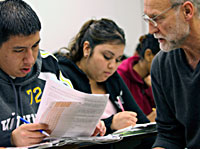 Learning communities by their very nature stress the interrelationships between ideas
and fields of study in settings, which promote collaboration and collegiality. The
fundamental purposes of learning communities are, therefore, to increase coherence
in and between subject matters, to reverse the intellectual fragmentation which many
disciplines tend to promote, and to encourage interaction between faculty and students,
among students themselves, and among faculty team members.
Learning communities by their very nature stress the interrelationships between ideas
and fields of study in settings, which promote collaboration and collegiality. The
fundamental purposes of learning communities are, therefore, to increase coherence
in and between subject matters, to reverse the intellectual fragmentation which many
disciplines tend to promote, and to encourage interaction between faculty and students,
among students themselves, and among faculty team members.
We have found that such communities allow us to focus on successful strategies for improving the learning and collaborative capabilities of students, as well as for increasing their retention and success in the classroom. Through participation in these communities, students have deepened their intellectual engagement with subject matter content while also improving skills development. As learning communities facilitate the student discovery process in interdisciplinary settings, the rich opportunities for faculty development and revitalization cannot be underestimated.
The De Anza learning communities program has been designed to insure student success, increase student comfort in the learning process, and assist the intellectual development of students by:
- increasing the interaction between all members of the teaching and learning situation;
- emphasizing the study of connections between disciplines and ideas;
- improving the likelihood that multiple perspectives will be respected and examined;
- increasing faculty awareness of a variety of teaching styles and approaches;
- encouraging students to be more responsible for their own learning and that of their peers.
The LinC Program is directed by a faculty coordinator and a 7-member advisory group composed of faculty, counselors and the staff development director. The coordinator facilitates the scheduling and implementation of learning communities and collaborates with faculty to insure the success of each learning community endeavor. Faculty interested in teaching in the program attend training workshops, consult with the coordinator and advisory group members, and submit a written proposal which includes integrated course content and assignments along with plans for including student services interventions and designated formative and summative assessment instruments. A counselor is assigned as a member of each learning community team to provide study skills support, academic advising and personal counseling.
Students can elect to enroll in a learning community at any point in their academic career. Foundational learning communities link pre-collegiate level classes in writing, reading, ESL, math, and study skills. Gateway learning communities link pre-collegiate level writing and math classes to general education transfer-level classes: i.e., writing and U.S. History; ESL and U.S. History; intermediate algebra and Introduction to Visual Arts; writing, reading, Sociology, and world wide web searching; reading, writing, and Oral Communication. General education learning communities link two or more transfer- level classes: i.e., English Composition and Introduction to Visual Arts, English Composition and Human Sexuality, English Composition and American Government, Philosophy and Anthropology, Psychology and Oral Communication, Statistics and Business.
Over the course of an academic year, LinC offers 25-30 different learning communities. Approximately 40 faculty and counselors and 750-1000 students participate in the program annually. Learning communities carry from 7-16 quarter units and comprise either a portion or the complete academic load for a student. Writing assignments vary depending on the level and nature of the learning community. Students may write journal entries, outlines, essays and research papers. These works may be expository, persuasive, analytical or creative depending on the focus of the particular learning community. Learning community pedagogy relies heavily on collaborative, experiential and active learning. These pedagogies engage students in activities in which they define and formulate issues, conduct research and analyze information, and present conclusions in original written and oral formats.
An important feature of De Anza's learning community work is the extensive, ongoing faculty development program undertaken in collaboration with the Office of Staff and Organizational Development. Expectations and guidelines for designing, implementing, and assessing learning community curriculum are explicit; faculty who want to teach in a learning community are supported by workshops and in-service professional development. Faculty are also introduced to the LinC Program's use of Small Group Instructional Feedback (SGIF) where staff routinely administer SGIFs in the fourth and tenth week of the quarter so students can collectively reflect on what is and is not working in their learning community. An analysis of student feedback is used to identify areas where faculty, collectively, need more training. The college provides budgetary support for conference travel, release time, workshops and a retreat off campus every quarter for faculty and staff in the LinC Program and anyone else who is interested.
Ongoing assessment and research based on data collection and analysis is viewed as a critical means for sustaining, improving, and expanding the LinC Program. With the support of the college and the district's institutional researchers, multiple assessment measures are used, including the Student Profile, success and persistence rates, Small Group Instructional Feedback (SGIF), reflective student essays, a student survey, student focus groups and a faculty survey. Retention (defined as completing the course) across all learning communities in the LinC Program is 85% or higher compared to the college-wide average of 60%. Student success (defined as passing the course with a grade of C or better) in learning communities is 90% or better. The most dramatic examples of student success have occurred in the general education classes which are linked or clustered with pre-collegiate classes. Our collected data shows success rates in these general education classes that are 10%-25% higher than in the same general education classes not in a learning community.
A longitudinal study of student feedback gathered using the Small Group Instruction Feedback Instrument has provided four compelling highlights:
- Students tell us that by teaching and learning from each other, they thrive because of the interactive and collaborative environment.
- Students perceive that teachers respect their opinions, encourage independent thought and value student feedback.
- Students report a marked improvement in study and communication skills, an increase in self-esteem and confidence, and a greater ability to handle stress associated with college work.
- Students further report increased understanding of content, confidence in their ability to analyze and write with greater clarity, an appreciation and understanding of connections and interrelationships, and a better sense of preparation for completing future college work.
The power and richness of the learning community experience is exemplified by students' recent comments:
"We belong to a learning community. We learn new things about each other in our small learning 'village.' I have met people I will not soon forget…Through our teachers we will grow and build valuable relationships…and move on, [but] what we gain will last a lifetime."
"I appreciated the multiple perspectives and more meaningful contexts that two teachers and an integrated curriculum provide."
"In our learning community, we had more interaction between teacher-teacher, teacher-classmate, and classmate-classmate. Not only were we a class group, we were also an excellent team of friends."